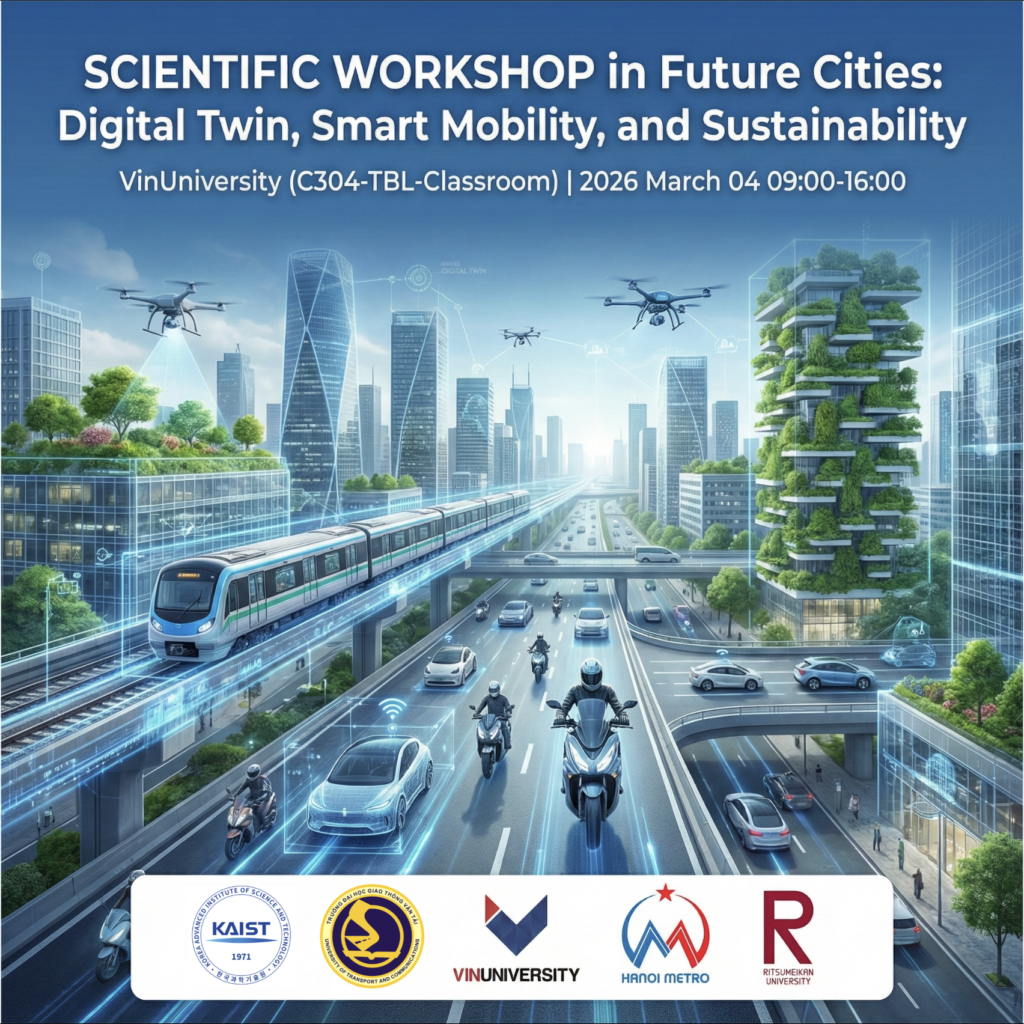
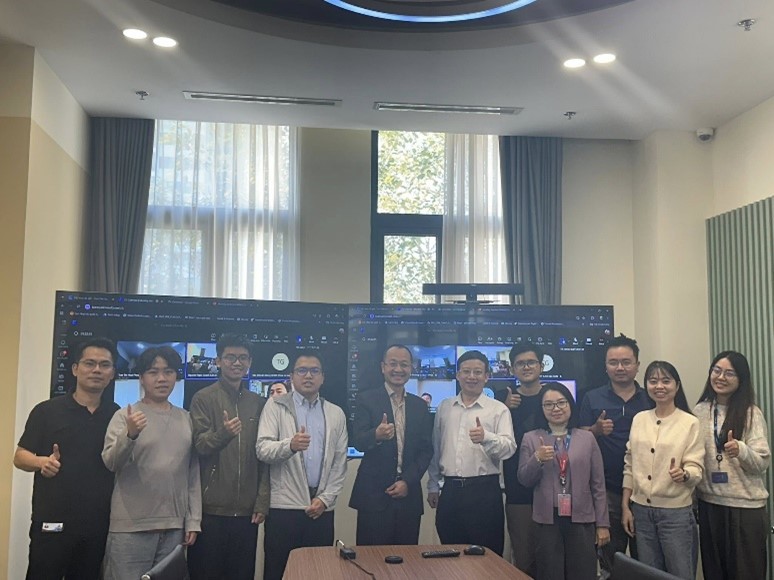
Event Announcement: SCIENTIFIC WORKSHOP in Future Cities
Join us for the upcoming SCIENTIFIC WORKSHOP in Future Cities: Digital Twin, Smart Mobility, and Sustainability.
Registration at: https://forms.gle/4J3mL3jECgsrbxzR7
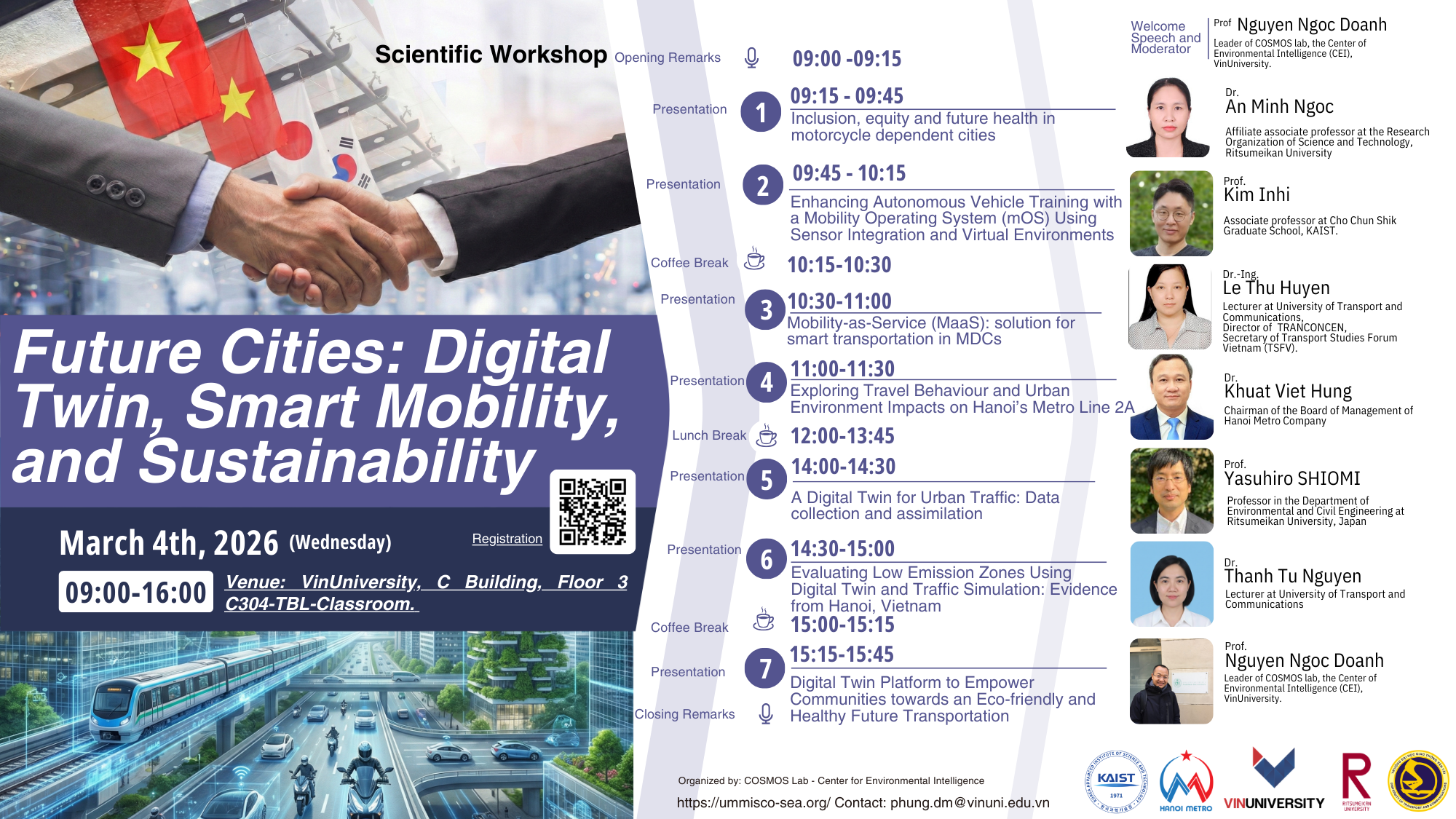
Event Details
-
Date: March 04, 2026
-
Time: 09:00 – 16:00
-
Location: C304-TBL-Classroom, Google Maps: VinUniversity
-
Host: COSMOS Lab, Center for Environmental Intelligence (CEI), VinUniversity
Workshop Agenda & Speaker Profiles
09:15-09:45 | Dr. An Minh Ngoc
-
Institution: RITSUMEIKAN UNIVERSITY
-
Topic: Inclusion, equity and future health in motorcycle dependent cities
-
Abstract: This presentation explores the critical challenges and potential pathways for achieving inclusion, equity, and improved public health within motorcycle-dependent cities (MDCs). MDCs are urban areas where reliance on motorcycles fundamentally shapes mobility, access to services, and overall urban development. High motorcycle density, particularly in countries like Vietnam, Indonesia, and Thailand, is linked to significant negative outcomes, including high fatality rates, the occupation of public spaces like sidewalks, and substantial local air and noise pollution. The research identifies a profound lack of transport options and inadequate infrastructure as primary drivers of exclusion from public transit systems. Case studies reveal significant accessibility inequities, where only a small fraction of the population (17.6%) is served by public transport, with even lower access for females (15.9%) and rural residents (3.8%). These systemic issues result in adverse health impacts, such as high crash rates, stress from noise pollution, and harmful exposure to ultrafine particles (UFPs) during commutes. To transition toward a healthier and more equitable future, the presentation contrasts the private- vehicle dependency of Ho Chi Minh City with the rail-integrated model of Tokyo, questioning whether cities should be designed for people or vehicles. Proposed solutions include adopting 15-Minute City principles and Transit-Oriented Development (TOD) standards to ensure essential services are within a short walk or bike ride. Technically, the research utilizes scenario simulations to model complex socio-environmental interactions. These models evaluate various pathways, such as enhanced bus. networks combined with road pricing, to shift modal shares toward more sustainable, “net-zero” emission goals by 2030 and 2050.
-
Biography: Dr. An Minh Ngoc is a senior lecturer at the University of Transport and Communications in Vietnam and is currently an affiliate associate professor at the Research Organization of Science and Technology, Ritsumeikan University in Japan. With a background in transport planning and economics, Ngoc has led a number of transport projects in various client provinces in Vietnam, covering a broad range of climate change in transport, transport connectivity, urban mobility, low-carbon transport strategies, and financing for green transport. Ngoc also contributes to the provision of training courses to support planning and the deployment of green growth action plans in the transport sector in various provinces in Vietnam. Ngoc worked with other international research centres in policy and planning, as well as in the management of programs and projects in the environment, transport, and international development fields. Ngoc holds an MSc in transport economics and a PhD in traffic management and has authored a dozen articles in high-ranking SSCI-indexed journals.
09:45-10:15 | Prof. Kim Inhi
-
Institution: KAIST
-
Topic & Abstract: environment. mOS facilitates the safe and scalable training of autonomous vehides under controlled. Enhancing Autonomous Vehicle Training with a Mobility Operating System (mOS) Using Sensor Integration and Virtual Environments To advance the safety and efficiency of autonomous vehicle training, we present a novel Mobility Operating System (mOS) implemented on the KAIST campus. This system leverages a network of diverse sensors deployed across the campus to collect real-time environmental data, enabling precise monitoring and analysis of dynamic conditions. By integrating this data into a sophisticated virtual yet realistic, scenarios. The virtual environment replicates complex real-world conditions, allowing vehicles to learn and adapt to challenging situations without physical risks. Our implementation demonstrates significant improvements in training efficiency, safety, and adaptability, paving the way for robust autonomous driving systems. This work highlights the potential of combining sensor- driven data collection with virtual simulation to revolutionize mobility solutions.
-
Biography: Before joining academia. Inhi worked as a transport engineer and planner in the Dr. Inhi Kim is an associate professor at Cho Chun Shik Graduate School, KAIST. He received his Ph.D. from the Department of Civil Engineering at the University of Queensland, Australia, in 2014. He joined the Department of at the University at Monash University, Melbourne, Australia, as a lecturer (Assistant Professor) in 2015 and a senior lecturer (Associate Professor) in 2019. Dr. Kim returned to his home country and accepted a new position as an associate professor at Kongju National University in 2019. German transport software company PTV Group. He gained five years of experience while based in Australia, Singapore, Germany, the United Arab Emirates, and Korea. As a practitioner, researcher, and trainer, he was closely involved with transport and traffic planning and modeling, evaluation, and performance measurement of transport programs and projects. Dr. Kim has particular interests and skills in deep learning, visualization, demand forecasting, strategic planning, traffic signal operation, public transportation planning, and safety in conjunction with the integration of traffic simulation and driving simulator, and evaluation of connected cars in safety and efficiency.
10:15-10:30 | TEA BREAK
10:30-11:00 | Dr.-Ing. Le Thu Huyen
-
Institution: UNIVERSITY OF TRANSPORT AND COMMUNICATIONS
-
Topic: Mobility-as-Service (MaaS): solution for smart transportation in MDCS
-
Abstract: Rapid urbanization and increasing travel demand have exerted significant pressure on the urban transportation in MDCS (Motorcycle Dependent City), leading to congestion, environmental degradation, and fragmented mobility services. In the context of future cities, Mobility-as-a-Service (MaaS) has emerged as a key technology-driven paradigm for smart mobility by enabling the integration of multiple transport modes within a unified digital platform. This paper explores MaaS as a smart mobility solution for Hanoi, a representative metropolitan city in a developing country, with a strong emphasis on digital technologies and system architecture. The study proposes a conceptual MaaS framework aligned with the future cities approach, highlighting the role of digital platforms, real-time data integration, and multimodal service orchestration. The framework is further positioned as a foundational layer for developing a transportation digital twin, enabling continuous monitoring, simulation, and optimization of urban mobility systems, taking different stakeholders’ interests into consideration. The results suggest that MaaS can enhance transport efficiency, accessibility, and sustainability in Hanoi while supporting data-driven decision-making for smart mobility govemance. The paper concludes by discussing technological and institutional prerequisites for implementing Maas as a core component of digital twin-enabled, sustainable urban transportation in future cities.
-
Biography: University of Transport and Communications, as a Lecturer, and also started to Dr.-Ing. Le Thu Huyen was born in Hanoi, Vietnam, in 1978. She received the B. E. degree in external commerce from Foreign Trade University, Hanoi in 2000, the Dipl. Eng. degree in Information Technology in Hanoi University of Technology, in 2000, and the MSc. Degree in Industrial System Engineering in Asian Institute of Technology, Bangkok, Thailand in 2002 and Dr.-Ing. degrees in Transport Planning and Traffic Engineering, Darmstadt University of Technology, Germany in 2009. In 2003, she joined the Section of Transport Planning and Management, work as the consultant in Consulting Center for Transport Development (TRANCONCEN) in the University. She became the Director of the Center since 2011. During the time, she has also had some scientific activities oversea, such as Exchange Researcher/Assistant Professor in Leeds University, Great Britain (2015), in Hiroshima University, Japan (2011). She has been the Research Team Leader of the Human Behavior Branch (Forum of Vietnam Traffic Safety), in National Traffic Safety Committee, since 2014. She is also the member of Eastern Asia Society for Transportation Studies (EASTS), and currently acting as the Secretary of Transport Studies Forum Vietnam (TSFV). Dr. Huyen has devoted 90 percent of her practice in the field of Transport Engineering for the last twenty years. She has extensive experience in traffic safety, urban traffic planning and management, as well as logistics and supply chain management. Her recent activities include giving lectures in the professional fields; doing research; providing consultant service to government, enterprises, etc..
11:00-11:30 | Dr. Khuat Viet Hung
-
Institution: HANOI METRO
-
Topic: Exploring Travel Behaviour and Urban Environment Impacts on Hanoi’s Metro Line 2A
-
Abstract: Urban railway systems serve as critical infrastructure in modern cities, fundamentally shaping mobility patterns and urban development. As Hanoi continues to expand its metro network, understanding the relationship between travel behavior and the built environment surrounding stations becomes essential for effective operation, maintenance, and future planning. Despite Metro Line 2A (Cat Linh – Ha Dong) being operational, a comprehensive analysis of passenger behaviours across different user groups and the impact of station-area characteristics remains limited. Analysing travel behaviour patterns of varying user groups and examining the relationship between urban railway use and the built environment along Hanoi Metro Line 2A are crucial.
-
Biography: Dr. Khuat Viet Hung is the Chairman of the Board of Management of Hanoi Metro Company. He holds a Doctor of Engineering in Transport Planning and Traffic Engineering from Darmstadt University of Technology (Germany), a Master of Engineering in Transportation Engineering from the Asian Institute of Technology (Thailand), and a Diplom-Engineer in Transport Economics from the University of Transport and Communications (Vietnam). Dr. Hung has more than 25 years of experience in transport policy, urban mobility planning, and public transport development. Prior to his current position, he served as Executive Vice Chairman of the National Traffic Safety Committee of Vietnam; Director General of the Transport Department and President of the Transport Development and Strategy Institute under the Ministry of Transport. Dr. Hung has led numerous national programs and advisory teams on sustainable transport, green energy transition, and traffic safety strategies, and has published extensively in international journals on topics such as urban transport, mobility, and infrastructure policy. He is also actively engaged in promoting integrated and sustainable urban transport systems in Vietnam, contributing to the modernization of the country’s railway and metro networks toward a safer, greener, and smarter mobility future.
12:00-13:45 | LUNCH
14:00-14:30 | Prof. Yasuhiro SHIOMI
-
Institution: RITSUMEIKAN UNIVERSITY
-
Topic: A Digital Twin for Urban Traffic: Data collection and assimilation
-
Abstract: This presentation introduces the concept of a digital twin for urban traffic systems, with a particular focus on data collection and data assimilation. A traffic digital twin is a virtual, continuously updated replica of the physical transport system that integrates real-time and historical data to monitor, analyze, and predict traffic conditions. The core of the presentation focuses on data assimilation techniques that fuse multi-source traffic data into dynamic traffic models. Methods such as Kalman filtering, particle filtering, and model-based updating are introduced to demonstrate how real-time observations can be combined with simulation and traffic flow models to improve state estimation and short-term forecasting.
-
Biography: Yasuhiro Shiomi, Ph.D is a Professor in the Department of Environmental and Civil Engineering at Ritsumeikan University, Japan. He received his Doctor of Engineering degree from Kyoto University in 2008. His research focuses on traffic engineering and transportation planning, including traffic flow modelling, driving behaviour analysis, freeway operation, and traffic safety policy. His core research areas include active and dynamic traffic management on expressways, theoretical and empirical analysis of traffic flow and congestion mechanisms, and optimal management of mixed traffic environments involving automobiles, motorcycles, pedestrians, and cyclists, particularly in Asian urban contexts. He has also contributed to studies on traffic system resilience to natural disasters and public transport service improvement. He has authored and co-authored numerous high-impact journal papers, books, and book chapters, including seminal works on bottleneck phenomena, flow breakdown, mixed traffic, and ITS applications. He is an active member of major professional societies, including the Eastern Asia Society for Transportation Studies, Japan Society of Civil Engineers, Japan Society of Traffic Engineers, and The City Planning Institute of Japan, and regularly contributes to international conferences and academic collaborations.
14:30-15:00 | Dr. Thanh Tu Nguyen
-
Institution: UNIVERSITY OF TRANSPORT AND COMUNIC
-
Topic: Evaluating Low Emission Zones Using Digital Twin and Traffic Simulation: Evidence from Hanoi, Vietnam
-
Abstract: Low Emission Zones (LEZs) are increasingly adopted to mitigate traffic-related emissions and improve urban environmental quality. However, evidence on their effectiveness in developing cities remains limited due to data constraints, complex travel behaviors, and high uncertainty in policy implementation. This study explores the application of a Digital Twin framework combined with traffic simulation to evaluate the potential impacts of LEZ policies in Hanoi, Vietnam. The proposed Digital Twin integrates traffic demand data, road network characteristics, vehicle fleet composition, and emission factors to construct a dynamic virtual representation of the urban transport system. By coupling traffic flow simulation with emission estimation models, the framework enables scenario-based evaluation of LEZ policies under different spatial boundaries, restriction levels, and enforcement periods. Several policy scenarios are examined, including access restrictions for highemission -vehicles in central urban areas and time-based LEZ implementation during peak periods. Simulation results indicate that LEZ implementation can lead to reductions in traffic volume and pollutant emissions within restricted zones, particularly for particulate matter (PM) and nitrogen oxides (NOx). Nevertheless, the magnitude of these benefits varies across scenarios and is strongly influenced by traffic re-routing effects and traveler behavioral responses. In some cases, emission reductions in the core area are partially offset by increased congestion and emissions in adjacent areas, underscoring the importance of system-wide assessment rather than localized evaluation. The study demonstrates that Digital Twin technology can function as a policy “sandbox” for testing LEZ strategies prior to real-world deployment. For developing cities such as Hanoi, Digital Twins provide a valuable decision-support tool to quantify trade-offs between environmental benefits and mobility performance, thereby supporting evidence-based and sustainable urban transport policy design.
-
Biography: Dr. Thanh Tu Nguyen is a lecturer and researcher specializing in transport planning and urban mobility. She received her Engineer degree from the University of Transport and Communications (UTC), Vietnam, in 2003. She then obtained her Master’s degree in Traffic Engineering from INSA Lyon, France, in 2004, and completed her Ph.D. in Economic Sciences at Université Paris 1 Panthéon-Sorbonne in 2013. She is currently a lecturer at the University of Transport and Communications (UTC), where she is involved in teaching and research in transport planning, urban transport systems, and logistics-related subjects. Dr. Nguyen has international research experience as a Visiting Researcher at the Laboratory of Economics and Sociology of Transport (DEST), French Institute of Science and Technology for Transport, Development and Networks (IFSTTAR), in 2017. She also participated in a short-term professional training program on transport and mobility organized by the German Federal Foreign Office in Berlin and Hannover in 2019. In addition, she has actively taken part in many national and international conferences and workshops in the field of transport and urban mobility. Her main research interests focus on transport planning, traffic simulation and modeling, travel demand analysis, and the evaluation of urban transport policies. She frequently applies traffic simulation tools to support research and practical projects related to urban transport systems. In recent years, her work has increasingly addressed sustainable urban mobility, smart mobility solutions, and decision-support approaches for transport policy-making in developing cities.
15:00-15:15 | TEA BREAK
15:15-15:45 | Prof. Nguyen Ngoc Doanh
-
Institution: VINUNIVERSITY
-
Biography: Doanh Nguyen Ngoc is an associate professor at CECS, VinUniversity. He is the leader of COSMOS lab, the Center of Environmental Intelligence (CEI), VinUniversity. His research is devoted to supporting interdisciplinary modeling- based approaches in large sustainability projects. In particular, he has developed a methodology to couple equation-based and agent-based models in the framework of digital twins to study complex socio-environmental systems (with topics as diverse as urban development, transportation, irrigation management, waste management, human epidemiology or fisheries management).